During the Renaissance Patrons of the Arts Were People Who Frequented Many Art Festivals

Catherine de' Medici'southward patronage of the arts made a significant contribution to the French Renaissance. Catherine was inspired by the example of her begetter-in-law, Male monarch Francis I of France (reigned 1515–1547), who had hosted the leading artists of Europe at his court. Every bit a immature woman, she witnessed at first hand the artistic flowering stimulated by his patronage.[1] As governor and regent of France, Catherine set out to imitate Francis's politics of magnificence. In an historic period of ceremonious war and declining respect for the monarchy, she sought to bolster royal prestige through lavish cultural display.
After the expiry of her hubby, Henry Ii, in 1559, Catherine governed France on behalf of her young sons King Francis II (1559–60) and King Charles IX (1560–74). Once in control of the regal bag, she launched a program of artistic patronage which lasted for three decades. She continued to use Italian artists and performers, including the artist-builder Primaticcio. Past the 1560s, even so, a moving ridge of home-grown talent—trained and influenced by the foreign masters brought to France by Francis—came to the fore. Catherine patronised these new artists and presided over a distinctive belatedly French Renaissance civilization. New forms emerged in literature, compages, and the performing arts.[two] At the same time, equally fine art historian Alexandra Zvereva suggests, Catherine became one of the great fine art collectors of the Renaissance.[three]
Although Catherine spent ruinous sums on the arts, the majority of her patronage had no lasting effect. The end of the Valois dynasty soon after her death brought a modify in priorities. Her collections were dispersed, her palaces sold, and her buildings were left unfinished or afterwards destroyed. Where Catherine had made her mark was in the magnificence and originality of her famous court festivals. Today's ballets and operas are distantly related to Catherine de' Medici'south courtroom productions.[4]
Visual arts [edit]
An inventory drawn upwards at the Hôtel de la Reine later on Catherine de' Medici'due south death shows that she was a keen collector of fine art and curiosities. Works of art included tapestries, hand-drawn maps, sculptures, and hundreds of pictures, many past Côme Dumoûtier and Benjamin Foulon, Catherine's last official painters. There were rich fabrics, ebony furniture inlaid with ivory, sets of china (probably from Bernard Palissy's workshop), and Limoges pottery. Curiosities included fans, dolls, caskets, games, pious objects, a stuffed chameleon, and seven stuffed crocodiles.[5]
By the time of Catherine'southward expiry in 1589, the Valois dynasty was in a terminal crisis; it became extinct with the decease of Henry Iii only a few months later. Catherine's backdrop and belongings were sold off to pay her debts and dispersed with fiddling anniversary. She had hoped for a far different posterity. In 1569, the Venetian ambassador had identified her with her Medici forebears: "1 recognises in the queen the spirit of her family. She wishes to leave a legacy behind her: buildings, libraries, collections of antiquities".[3] Despite the destruction, loss, and fragmentation of Catherine'due south heritage, a collection of portraits formerly in her possession has been assembled at the Musée Condé, Château de Chantilly.
Portraits [edit]

The vogue for portrait drawings intensified during Catherine de' Medici's life, and she may have regarded role of her collection every bit the equivalent of today's family photograph anthology. Catherine loved having her children painted: "I would like", she wrote in 1547 to her children's governor, Jean d'Humières, "to accept paintings of all the children done . . . and sent to me, without delay, as soon as they are finished".[6] However, the more formal pictures include a high proportion of portraits of European kings and queens, past and present, most of which she probably deputed personally.[vii] On 3 July 1571, Catherine wrote to Monsieur de la Mothe-Fénelon, ambassador in London, discussing the work of François Clouet and requesting a portrait of Queen Elizabeth. Catherine gave detailed instructions: "I pray y'all do me the pleasure that I may soon have a painting of the queen of England of modest volume, in great [de la grandeur], and that it be well portrayed and done in the same way equally the one sent be by the earl of Leicester, and ask, equally I already take one in total face, it would exist ameliorate to take her turning to the right."[8] The big grouping of portraits from Catherine'southward drove, now at the Musée Condé, Château de Chantilly, reveals her passion for the genre.[ix] These include portraits past Jean Clouet (1480–1541) and by his son François Clouet (c. 1510–1572). Jean drew and painted in the manner of the Italian High Renaissance, only in the portraits of François, a northern-European naturalism is apparent, and a flatter, more meticulous technique.[x]
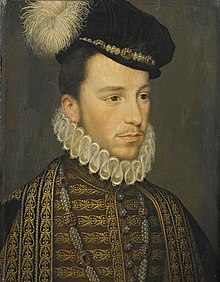
François Clouet drew and painted portraits of all Catherine'south family unit too equally of many members of the court. His drawing has been called profound, attributable to its accuracy and harmony of form and its psychological penetration.[12] This tradition of court portraiture was carried on by Jean Decourt, Étienne, Côme, and Pierre Dumoûtier, and by the less polished Benjamin Foulon (François Clouet'south nephew) and François Quesnel. The last two artists, plus another known as "Anonyme Lécurieux", tended to use a more stylised technique, producing flatter portraits, with less 3-dimensional modelling.[13] After the death of Catherine de' Medici, a decline in the quality of portraiture prepare in; and by 1610, the native schoolhouse patronised by the tardily Valois courtroom and brought to its peak by François Clouet had all only died out, and the Bourbon became reliant on foreign artists.[fourteen]
Painting [edit]

Petty is known about the painting at Catherine de' Medici'due south court.[15] In the last two decades of Catherine's life, but two painters stand out as recognisable personalities, Antoine Caron and Jean Cousin the Younger. The majority of paintings and portrait drawings that accept survived from the late Valois menses remain difficult or impossible to attribute to detail artists.
Antoine Caron became painter to Catherine de' Medici later working at Fontainebleau under Primaticcio. His vivid Mannerist style, with its dear of ceremonial and allegory, mayhap reflects the peculiarly neurotic temper of the French courtroom during the Wars of Religion.[16] He adopted from Niccolò dell'Abbate the technique of elongated and twisted figures, placing them in spaces dominated by fantastical fragments of architecture borrowed from the drawings of Jacques Androuet du Cerceau and painted in surprising rainbow contrasts. The event makes Caron's pivot-headed figures appear puny and lost in the landscapes.[17]
Many of Caron'due south paintings, such as those of the Triumphs of the Seasons, are of allegorical subjects that echo the festivities for which Catherine'southward court was famous. His designs for the Valois Tapestries depict the fêtes, picnics, and mock battles of the "magnificent" entertainments for which Catherine was famous.[eighteen] Caron often painted scenes of massacres, reflecting the background of civil war that cast a shadow over the magnificence of the court. Caron also painted astrological and prophetical subjects, such equally Astrologers Studying an Eclipse and Augustus and the Sibyl. This theme may have been inspired by Catherine de' Medici's obsession with horoscopes and predictions.[17]
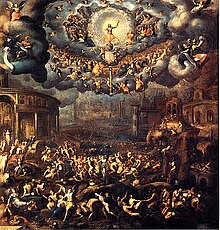
Jean Cousin, to judge by contemporary praise for his piece of work, may have been as highly regarded at the time as Caron. The majestic accounts show large payments made to Cousin: he was amongst those who decorated Paris for the entry of Henry Ii as rex. Little of his piece of work, even so, survives. His most important surviving piece of work is The Final Judgement in the Louvre, which similar Caron's art, depicts man beings dwarfed by the landscape and, in Blunt's words, "fabricated to swarm over the earth like worms".[17]
Tapestries [edit]
Missing from the inventory fatigued upward after Catherine's expiry were the eight huge tapestries, known every bit the Valois tapestries, now held at the Uffizi gallery in Florence, which depict "magnificences" such as those at Bayonne in 1565 during the top meeting betwixt the French and Spanish courts and the ball laid on at the Tuileries palace in 1573 by Catherine for the Polish envoys who offered the crown of their country to her son Henry of Anjou.[nineteen] These magnificent hangings, originally designed during the reign of Rex Charles IX by Antoine Caron in the early 1570s,[20] were woven later in the Spanish Netherlands with additions, peradventure designed past Lucas de Heere,[21] who worked for Catherine betwixt 1559 and 1565,[22] that show fashions as late as 1580 and describe Henry 3 as king rather than Charles IX.[19]
Historian Frances Yates has suggested that these tapestries may have been produced in connection with the intervention of Catherine'southward son François, Knuckles of Anjou, who was elected duke of Brabant, in the Spanish Netherlands in 1580, in defiance of the Spanish administration. Anjou figures prominently in the tapestries. Catherine de' Medici herself appears equally a central figure in black in most of them.[23] It is believed that she gave them to her granddaughter Christina of Lorraine in advance of her wedding to Ferdinand de' Medici, Chiliad Duke of Tuscany in 1589.[23] The tapestries glorify the firm of Valois by jubilant its magnificent festivals.[1]
Sculpture [edit]
According to the contemporary art historian Vasari, Catherine wanted Michelangelo to brand her husband Henry II'southward equestrian statue; but Michelangelo passed the commission on to Daniele da Volterra, and only the horse was ever made.[24]

On commission from Catherine, Germain Pilon carved the marble sculpture that contains Henry 2'south eye. The Florentine Domenico del Barbiere, who had worked at Fontainebleau, carved the base. Pilon's fluid mode echoes Primaticcio's stucco work at Fontainebleau. The slice may too have been influenced by Pierre Bontemps's monument for the center of Francis I.[25] Pilon set the bronze urn on the heads of the Three Graces, who are poised back to dorsum, equally if to trip the light fantastic toe.[26] He may take based the blueprint on that for an incense burner for Francis I, engraved by Marcantonio. Pilon's figures, however, with their long necks and pocket-size heads, are more like nymphs.[25] A poem past Ronsard is engraved at the foot of the sculpture. It asks the reader not to wonder that so modest a vase tin can hold and so large a center, since Henry'south existent heart resides in Catherine'due south chest.[27] Henri Zerner has chosen the monument, which tin be seen at the Louvre, "one of the summits of our sculpture".[28]
In the 1580s, Pilon began piece of work on statues for the chapels that were to circumvolve the tomb of Catherine de' Medici and Henry Two at the basilica of Saint Denis. Amongst these, the fragmentary Resurrection, now in the Louvre, was designed to face the tomb of Catherine and Henry from a side chapel.[29] This work owes a clear debt to Michelangelo, who had designed the tomb and funerary statues for Catherine's father at the Medici chapels in Florence.[thirty] Pilon openly depicted extreme emotion in his piece of work, sometimes to the betoken of the grotesque. His style has been interpreted every bit a reflection of a gild torn past the disharmonize of the French wars of organized religion.[31]
Architecture [edit]

Architecture was Catherine de' Medici's first honey among the arts. "As the daughter of the Medici", suggests French fine art historian Jean-Pierre Babelon, "she was driven by a passion to build and a desire to get out great achievements behind her when she died."[32] Having witnessed in her youth the huge architectural schemes of Francis I at Chambord and Fontainebleau, Catherine gear up out, after Henry Ii's death, to enhance the grandeur of the Valois monarchy through a serial of costly edifice projects.[33] These included piece of work on châteaux at Montceaux-en-Brie, Saint-Maur-des-Fossés, and Chenonceau, and the building of two new palaces in Paris: the Tuileries and the Hôtel de la Reine. Catherine was closely involved in the planning and supervising of all her architectural schemes.[34] Architects of the day dedicated treatises to her in the sure knowledge that she would read them.[35] The poet Ronsard accused her of preferring masons to poets.[36]

Catherine was intent on immortalising her sorrow at the expiry of her married man and had emblems of her honey and grief carved into the stonework of her buildings.[38] As the centrepiece of an ambitious new chapel, she commissioned a magnificent tomb for Henry at the basilica of Saint Denis, designed by Francesco Primaticcio. In a long verse form of 1562, Nicolas Houël, laying stress on her beloved for architecture, likened Catherine to Artemisia, who had built the Mausoleum at Halicarnassus, one of the Seven Wonders of the Ancient Earth, as a tomb for her dead husband.[39] Primaticcio's circular plan for the Valois chapel, by allowing the tomb to be viewed from all angles, solved the problems faced by the Giusti brothers and Philibert de l'Orme, builders of previous royal tombs.[xl] Art historian Henri Zerner has called the design "a yard ritualistic drama which would have filled the rotunda's celestial space" and "the final and most vivid of the purple tombs of the Renaissance".[41] Work on the edifice was abased in 1585, as the monarchy faced defalcation and a series of rebellions. Over two hundred years afterward, in 1793, a mob tossed Catherine and Henry's bones into a pit with the rest of the French kings and queens.[42]
Catherine de' Medici spent extravagant sums on the building and embellishment of monuments and palaces, and as the state slipped deeper into chaos, her plans grew e'er more than ambitious.[43] Yet the Valois monarchy was crippled past debt and its moral authority in steep refuse. The popular view condemned Catherine'southward building schemes as obscenely wasteful. This was peculiarly true in Paris, where the parlement was oftentimes asked to contribute to her costs.
Ronsard captured the mood in a poem:
- The queen must cease edifice,
- Her lime must terminate swallowing our wealth…
- Painters, masons, engravers, stone-carvers
- Drain the treasury with their deceits.
- Of what use is her Tuileries to united states?
- Of none, Moreau; information technology is just vanity.
- It will be deserted within a hundred years. [44]
Ronsard was in many ways proved correct. Little remains of Catherine de' Medici's investment today: one Doric column, a few fragments in the corner of the Tuileries gardens, an empty tomb at Saint Denis.
Literature [edit]

Astrologers Studying an Eclipse, by Antoine Caron: Catherine was fascinated by astronomy and astrology and had a belfry built, the Colonne de l'Horoscope, peradventure used for observation of the stars.[38]
Catherine believed in the humanist ideal of the learned Renaissance prince whose ability depended on letters every bit well as arms, and she was familiar with the writing of Erasmus, among others, on the field of study.[45] She enjoyed and collected books, and moved the majestic collection to the Louvre, her chief residence. She delighted in the company of learned men and women, and her court was highly literary. Her authorities officials, such as secretarial assistant-of-state Nicolas de Neufville, seigneur de Villeroy, whose married woman translated the epistles of Ovid, were perfectly at home in literary circles.[46] When she could notice the time, Catherine occasionally wrote verses herself, which she would show to the court poets.[47] Her reading was not entirely highbrow, however. A superstitious woman, she believed implicitly in star divination and soothsaying, and her reading thing included The Book of Sibyls and the almanacs of Nostradamus.[48]
Catherine patronised poets such as Pierre de Ronsard, Rémy Belleau, Jean-Antoine de Baïf, and Jean Dorat, who wrote verses, scripts, and associated literature for her court festivals, and for public events such every bit purple entries and royal weddings.[49] Catherine even had Ronsard write a poem to Elizabeth of England, honouring a new peace treaty.[l] These poets were part of a grouping sometimes known as the Pléiade, who forged a vernacular French literature on Greek and Latin models. They gave form to their interest in ancient poesy in vers mesurés, a metric system that aspired to imitate classical poetic rhythms. Catherine de' Medici was also interested in Italian literature: Tasso presented his Rinaldo to her, and Aretino eulogised her as "woman and goddess serene and pure, the majesty of beings man and divine".[51]
Theatre [edit]
In 1559, Catherine and Henry II attended a functioning of the tragedy Sophonisba by Trissino, adjusted earlier by the poet Mellin de Saint-Gelais to Catherine's commission.[52] The functioning style of the day inserted musical interludes unrelated to the plot between the acts, devoted to praise of the royal court. Princesses and other high-ranking ladies performed on this occasion, which celebrated royal and noble marriages.[51] Pierre de Bourdeille, seigneur de Brantôme, claimed in his memoirs that having seen Sophonisba shortly earlier her husband'southward death, Catherine refused to watch whatever more tragedies, believing the play had brought him bad luck. Tragedy went out of fashion at the court soon afterwards, replaced by the new genre of tragicomedy, though the change in gustation may take had less directly to practice with Catherine than with the revulsion of the court against the violence of the times.[51] Genevra, staged at Fontainebleau on 13 February 1564, adapted into French from an episode of Ariosto'due south Orlando Furioso, was the get-go tragicomedy known to have been performed for the French court.[51]

Catherine enjoyed one-act and risqué humor. She drew the line at obscenity, all the same: in 1567, later seeing Le Dauntless, an adaptation of Plautus'south Miles Gloriosus past one of her official poets Jean-Antoine de Baïf, Catherine told the author to cut the "lascivious talk" of the classical writers.[53] In the 1570s, the Italian commedia dell'arte rose to popularity in France and became all the rage.[54] Catherine was not, as has sometimes been supposed, the first to bring Italian comedy to France: Louis Gonzaga, Knuckles of Nevers, himself an Italian, was the first to invite high-quality Italian players to France in 1571. The following year, two companies called I Gelosi appeared in Paris, and a functioning was given to the court in Blois. A year later, I Gelosi performed during the celebrations for the spousal relationship of Catherine's daughter Marguerite de Valois and Henry of Navarre. Farther groups appeared under the same name in the reign of Catherine's son Henry 3 (1574–89).
Courtroom festivals [edit]
As queen consort of French republic, Catherine patronised the arts and the theatre, but not until she attained real political and fiscal power as queen female parent did she begin the series of tournaments and entertainments, sometimes called "magnificences", that dazzled her contemporaries and proceed to fascinate scholars. The most famous of these were the court festivals mounted at Fontainebleau and at Bayonne during Charles IX'southward royal progress of 1564–65; the entertainments for the Smoothen ambassadors at the Tuileries in 1573; and the celebrations following the marriages of Catherine's daughter Marguerite to Henry of Navarre in 1572 and of her daughter-in-constabulary'southward sis, Marguerite of Lorraine, to Anne, Duke of Joyeuse, in 1581. On all these occasions, Catherine organised sequences of lavish and spectacular entertainments. Biographer Leonie Frieda suggests that "Catherine, more than than anyone, inaugurated the fantastic entertainments for which later on French monarchs also became renowned".[55]
For Catherine, these entertainments were worth their colossal expense, since they served a political purpose. Presiding over the royal government at a time when the French monarchy was in steep decline, she ready out to evidence not only the French people but foreign courts that the Valois monarchy was every bit prestigious and magnificent equally it had been during the reigns of Francis I and her husband Henry 2.[56] At the same time, she believed these elaborate entertainments and sumptuous court rituals, which incorporated martial sports and tournaments of many kinds, would occupy her feuding nobles and distract them from fighting against each other to the detriment of the state and the regal authority.[57]
Information technology is articulate, withal, that Catherine regarded these festivals as more than a political and businesslike exercise; she revelled in them as a vehicle for her creative gifts. A highly talented and artistic woman, Catherine took the lead in devising and planning her ain musical-mythological shows and is regarded as their creator as well as their sponsor. Historian Frances Yates has called her "a great artistic artist in festivals".[58] Though they were ephemeral, Catherine's "magnificences" are studied by modern scholars every bit works of art.[55] Catherine employed the leading writers, artists, and architects of the day, including Antoine Caron, Germain Pilon, and Pierre Ronsard, to create the dramas, music, scenic effects, and decorative works required to animate the themes of the festivals, which were usually mythological and dedicated to the platonic of peace in the realm. It is difficult for scholars to reconstruct the verbal grade of Catherine's entertainments, but research into the written accounts, scripts, artworks, and tapestries that derived from these famous occasions has provided evidence of their richness and scale.
In the tradition of 16th-century royal festivals, Catherine de' Medici'due south magnificences took place over several days, with a dissimilar entertainment on each day. Oft individual lords and ladies and members of the purple family were responsible for preparing one particular entertainment. Spectators and participants, including those involved in martial sports, would dress up in costumes representing mythological or romantic themes. Catherine gradually introduced changes to the traditional class of these entertainments. She forbade heavy tilting of the sort that led to the decease of her married man in 1559; and she adult and increased the prominence of dance in the shows that climaxed each serial of entertainments.
Dance [edit]
A distinctive new fine art form, the ballet de cour, emerged from the creative advances in court entertainment devised past Catherine de' Medici.[59] The Italian influence on the ballet de cour owed much to Catherine, who was Italian herself and had grown up in Florence, where intermedii, patronised by her rich relatives, were a staple of courtroom entertainments and a focus of innovation. These between-acts entertainments had evolved a unique artistic form of their ain, with choral dances, masquerades (mascherate), and consecutive themes.[60] Once in France, Catherine kept in touch with creative innovations in Italia. She encouraged Italian dancing masters to accept posts in France, among them the Milanese Cesare Negri, who introduced the skills of figured dancing to France, and Pompeo Diobono, whom Catherine employed as dancing main to her iv sons.[61] The most significant effigy was Balthasar de Beaujoyeulx (his name gallicised from the Italian Baldassare da Belgiojoso), whom Catherine placed in charge of training dancers and producing performances at court.[62]
Historian Frances Yates has credited Catherine as the guiding light of the ballets de cour:
It was invented in the context of the chivalrous pastimes of the court, by an Italian, and a Medici, the Queen Mother. Many poets, artists, musicians, choreographers, contributed to the result, merely it was she who was the inventor, one might perhaps say, the producer; she who had the ladies of her courtroom trained to perform these ballets in settings of her devising.[58]
The dance performances at the Valois court were conceived on a large scale, as elaborate, choreographed showpieces, sometimes performed by considerable forces. At the Château of Fontainebleau in 1564, the courtroom attended a ball in which 300 "beauties dressed in gilt and argent cloth" performed a choreographed dance.[63] In his illustrated Magnificentissimi spectaculi, Jean Dorat described an intricate ballet, The Ballet of the Provinces of France, performed for the Polish ambassadors at the Tuileries palace in 1573, in which xvi nymphs, each representing a French province, distributed devices to the spectators every bit they danced. Choreographed by Beaujoyeulx, the dancers performed complex, interlaced figures and patterned movements, each expressing a certain moral or spiritual truth that the spectators, assisted by printed programmes, were expected to recognise.[64] The chronicler Agrippa d'Aubigné recorded that the Poles marvelled at the ballet.[65] Brantôme chosen the functioning "the finest ballet that was e'er given in this world" and praised Catherine for bringing prestige to France with "all these inventions".[65] Jean Dorat described the movements of the dancers in verse:
- They blend a thousand flights with a k pauses of the feet
- At present they sew through 1 another like bees by holding hands
- At present they form a point similar a flock of voiceless cranes.
- Now they draw close, intertwining with i some other
- Creating an entangled hedge like a kind of brier bush.
- At present this one and now that switches to a flat figure
- Which describes many letters without a tablet.[66]
After the dance was over, Catherine invited the spectators to join with the performers in a social dance.

Over the years, Catherine increased the element of dance in her festive entertainments, and information technology became the norm for a major ballet to climax each series of magnificences. The Ballet Comique de la Reine, devised under Catherine's influence, by Queen Louise for the Joyeuse Magnificences of 1581, is regarded past historians as the moment when the ballet de cour assumed the character of a new art class. The theme of the entertainment was an invocation of cosmic forces to aid the monarchy, which at that fourth dimension was threatened by the rebellion non only of Huguenots but of many Catholic nobles. Men were shown as reduced to beasts by Circe, who held courtroom in a garden at ane stop of the hall. Louise and her ladies, costumed equally naiads, entered on a chariot designed as a fountain and and then danced a ballet of xiii geometric figures. Afterward being turned to stone by Circe, they were freed to dance a ballet of forty geometric figures. 4 groups of dancers, each wearing a different-coloured costume, moved through a sequence of patterns, including squares, triangles, circles, and spirals.[67]
The figured choreography that enacted the mythological and symbolic themes reflected the principle, derived from the Enneads of Plotinus (c. 205–270), of "catholic trip the light fantastic toe", the imitation of heavenly bodies by human move to produce harmony. This imitation was achieved in the dance through geometric choreography and figures based on the harmony of numbers.[68] The dance elements in the court festivities represented a response to the increasing political disharmony of the country.[64] The Ballet Comique de la Reine marked the final transformation of court trip the light fantastic every bit a purely personal and social activity into a unified theatrical performance with a philosophical and political agenda.[69] Owing to its synthesis of trip the light fantastic, music, verse, and setting, the production is regarded by scholars every bit the offset accurate ballet.[70]
Music [edit]
The trip the light fantastic toe, verse, and musical elements of Catherine'southward entertainments increasingly reflected the principles of an bookish move—also influential in the Florentine Camerata—to unify the performing arts in what was believed to exist the classical, Greek way. In 1570, Jean-Antoine de Baïf founded the Académie de Poésie et de Musique, whose aim was to revive ancient metrical practices, and, though the academy was curt lived, similar aims were adopted by the Académie du Palais, founded in 1577. Both enterprises were supported by the Valois court. One event of this movement was Musique mesurée à l'antiquarian, in which the metres of music and verse were matched precisely, to create a new harmony. The theory was not only technical simply humanistic; practitioners believed a harmonious combination of elements would produce benign moral and upstanding effects on the audience. Trip the light fantastic toe was also discipline to the new system and was designed to match the rhythms of the music and poesy. The result was a new unified approach to the interrelationship betwixt the performing arts.[71]
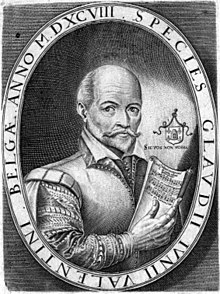
Claude Le Jeune, the leading composer of the twenty-four hour period, wrote music for Catherine de' Medici's entertainments and for court ceremonies and religious occasions
The well-documented Joyeuse magnificences of 1581 provide the clearest evidence of the influence of this artistic move on Catherine de' Medici's entertainments. The principal composer of music for the performances was Claude Le Jeune (1528–1600). His musique mesurée was played at the wedding itself, and his vocal "La Guerre" was sung during a pes-combat in the Louvre. He also wrote the music for an elaborate show on a sun-moon theme, once again setting vers mesurés to musique mesurée.[72] For the Ballet Comique de la Reine, the music was composed past the Sieur de Beaulieu. The musicians were fully incorporated in the dramatic whole: on one side of the performing infinite was a cloud containing costumed singers and musicians, and on the other, a grotto, guarded by Pan, containing a 2d band of musicians. Further groups of singers and musicians fabricated diverse entries and exits during the five-and-a-half-hour performance. At one stage, Circe turned the dancers and musicians to stone.[73] When, at the climax of the show, Jupiter descended from the heavens, 40 singers and musicians performed a song in laurels of the wisdom and virtue of the Valois monarchy.[74] Published accounts praised the length and variety of the music. The Jupiter music was chosen the "most learned and first-class music that had ever been sung or heard".[75]
Notes [edit]
- ^ a b Knecht, 244.
- ^ Knecht, 220.
- ^ a b Zvereva, six.
- ^ Knecht, 245.
- ^ Knecht, 240–41.
- ^ Frieda, 109.
- ^ Dimier, 195. The similarity in sizes suggests that they were ordered to her specifications.
- ^ Jollet, 50: Correspondance Diplomatique De Bertrand De Salignac De La Mothe Fenelon, vol. half dozen, (1840), 229-231, three July 1571
- ^ See Zvereva, Les Clouet de Catherine de Médicis, 2002.
- ^ Blunt, 73.
- ^ Dimier, 239.
- ^ Dimier, 205–half-dozen.
- ^ Edgeless, 100; Jollet, 249–52.
- ^ Dimier, 308–nineteen; Jollet, 17–18. Technically, François Clouet'south origins were Flemish, since his father had arrived in Paris from Flanders prior to 1528; but François lived almost all of his life in French republic
- ^ "There are few periods at which French painting was at a lower ebb than in the last quarter of the sixteenth century and the first quarter of the seventeenth, and few periods about which we are more ignorant." Blunt, 98.
- ^ Blunt calls Caron's style "perhaps the purest known type of Mannerism in its elegant form, appropriate to an exquisite but neurotic lodge". Blunt, 98, 100.
- ^ a b c Blunt, 100.
- ^ Blunt, 98.
- ^ a b Knecht, 242–43.
- ^ Dimier, 190. Caron was also responsible for a series of cartoons for tapestries on the theme of Artemisia, in award of Catherine de' Medici.
- ^ See The Valois Tapestries (1959), by Frances Yates, who proposed de Heere every bit the designer of the additions.
- ^ Dimier, 216. The information near de Heere comes from Karel van Mander (1548–1606).
- ^ a b Knecht, 242.
- ^ Blunt, 282; Knecht, 225. Da Volterra died in 1566. The horse did not reach France until the seventeenth century, when information technology was utilised for an equestrian statue of Louis XIII. It was melted downwards during the French revolution.
- ^ a b Blunt, 94.
- ^ Hoogvliet, 110.
- ^ Hoogvliet, 111. Ronsard may refer to Artemisia, who drank the ashes of her dead husband, which fused with her ain trunk.
- ^ Knecht, 225, quotes Henri Zerner, 50'art de la Renaissance en France. L'invention du classicisme, Paris: Flammarion, 1996, 354. The urn is a nineteenth-century restoration.
- ^ Zerner, 383. Whereas the Resurrection for the tomb of Francis I had been positioned shut to the corpses, this design would accept involved the visitor.
- ^ Blunt, 95. Pilon based the Christ on Michelangelo's drawing for Noli me tangere (1531) and carved the soldiers in Michelangelo'south contrapposto manner.
- ^ Blunt, 96–97.
- ^ Babelon, 263.
- ^ Frieda, 79, 455; Sutherland, Ancien Régime, 6.
- ^ De 50'Orme wrote that Catherine, with "an admirable understanding combined with not bad prudence and wisdom", took the trouble "to order the organization of her said palace [the Tuileries] as to the apartments and location of the halls, antechambers, chambers, closets and galleries, and to requite the measurements of width and length". Quoted by Knecht, 228.
- ^ Blunt, 91. For example, Jacques Androuet du Cerceau defended his Les Plus Excellents Bastiments de France (1576 and 1579) to Catherine.
- ^ Knecht, 228.
- ^ Knecht, 227. Henry'due south gesture is now unclear, since a missal, resting on a prie-dieu (prayer desk-bound), was removed from the sculpture during the French revolution and melted down.
- ^ a b Knecht, 223.
- ^ Frieda, 266; Hoogvliet, 108. Louis Le Roy, in his Ad illustrissimam reginam D. Catherinam Medicem of 1560, was the kickoff to call Catherine the "new Artemisia".
- ^ Blunt, 56.
- ^ Fifty'fine art de la Renaissance en France. L'invention du classicisme (Zerner, 1996: 349–54), quoted past Knecht, 227; Zerner, 379.
- ^ Knecht, 269.
- ^ Thomson, 168.
- ^ Quoted in Knecht, 233. Ronsard addressed these lines to the financial official Raoul Moreau. Au tresorier de fifty'esparne (ca. 1573).
- ^ Hoogvliet, 109.
- ^ Sutherland, Secretaries of Land, 153–56.
- ^ Heritier, 460.
- ^ Knecht, 221, 244–45
- ^ Frieda, 105.
- ^ Heritier, 238–39.
- ^ a b c d Knecht, 234.
- ^ Plazenet, 261.
- ^ Knecht, 235.
- ^ Heller, 104.
- ^ a b Frieda, 225.
- ^ Stiff, 99.
- ^ Yates, 51–52.
• Catherine wrote to Charles IX: "I heard it said to your granddad the Male monarch that two things were necessary to alive in peace with the French and have them dear their Male monarch: keep them happy, and decorated at some do, notably tournaments; for the French are accepted, if at that place is no war, to exercise themselves and if they are not made to exercise so they employ themselves to more than dangerous [ends]". Quoted in Jollet, 111. - ^ a b Yates, 68.
- ^ Yates, 51; Potent, 102, 121–22.
- ^ Shearman, 105.
- ^ Lee, 39.
- ^ Lee, 40–42.
- ^ Frieda, 211.
- ^ a b Lee, 42.
- ^ a b Knecht, 239.
- ^ Quoted in Lee, 43.
- ^ Lee, 45; Strong, 120–21.
- ^ Lee, 41–42.
- ^ Lee, 41. See also Orchésographie (1588) by Thoinot Arbeau, the first publication to notate—in relation to music—the steps taken from social dances.
- ^ Lee, 44.
- ^ Strong, 102.
- ^ Potent, 118.
- ^ Strong, 119–20.
- ^ Strong, 121.
- ^ Knecht, 241.
Bibliography [edit]
- Babelon, Jean-Pierre. "The Louvre: Royal Residence and Temple of the Arts". Realms of Retention: The Construction of the French By. Vol. 3: Symbols. Edited by Pierre Nora. English language edition translated by Arthur Goldhammer, edited by Lawrence D. Kritzman. New York: Columbia University Press, 1998. ISBN 0-231-10926-1.
- Blunt, Anthony. Fine art and Architecture in French republic: 1500–1700. New Haven, Connecticut: Yale Academy Press, [1957] 1999 edition. ISBN 0-300-07748-3.
- Brantôme, Pierre de Bourdeille, seigneur de. Illustrious Dames of the Court of the Valois Kings. Translated by Katharine Prescott Wormeley. New York: Lamb, 1912. OCLC 347527.
- Chastel, André. French Fine art: The Renaissance, 1430–1620. Translated by Deke Dusinberre. Paris: Flammarion, 1995. ISBN ii-08-013583-X.
- Cloulas, Ivan, and Michelle Bimbenet-Privat. Treasures of the French Renaissance. Translated by John Goodman. New York: Harry N. Abrams, 1998. ISBN 0-8109-3883-9.
- Dimier, L. French Painting in the XVI Century. Translated by Harold Child. London: Duckworth, 1904. OCLC 86065266.
- Frieda, Leonie. Catherine de Medici. London: Phoenix, 2005. ISBN 0-75-382039-0.
- Heller, Henry. Anti-Italianism in Sixteenth-Century France. Toronto: Academy of Toronto Press, 2003. ISBN 0-8020-3689-9.
- Heritier, Jean. Catherine de' Medici. Translated by Charlotte Haldane. London: George Allen and Unwin, 1963. OCLC 1678642.
- Hoogvliet, Margriet. "Princely Culture and Catherine de Médicis". In Princes and Princely Culture, 1450-1650. Edited by Gosman, Martin; Alasdair A. MacDonald, and Arie Johan Vanderjagt. Leiden and Boston, Massachusetts: Brill Academic, 2003. ISBN 90-04-13572-3.
- Jardine, Lisa, and Jerry Brotton. Global Interests: Renaissance Art Betwixt E And West. London: Reaktion Books, 2005. ISBN 1-86189-166-0.
- Jollet, Etienne. Jean et François Clouet. Translated by Deke Dusinberre. Paris: Lagune, 1997. ISBN 0-500-97465-9.
- Knecht, R. J. Catherine de' Medici. London and New York: Longman, 1998. ISBN 0-582-08241-2.
- Lee, Carol. Ballet in Western Civilisation: A History of Its Origins and Evolution. London: Routledge, 2002. ISBN 0-415-94256-X.
- McGowan, Margaret. Dance in the Renaissance: European Fashion, French Obsession. New Haven: Yale University Press, 2008. ISBN 0-300-11557-1.
- Plazenet, Laurence. "Jacques Amyot and the Greek Novel". In The Classical Heritage in France. Edited past Gerald Sandy. Leiden and Boston, Massachusetts: Brill Academic, 2002. ISBN 90-04-11916-7.
- Shearman, John. Mannerism. London: Penguin, 1967. ISBN 0-14-020808-nine.
- Strong, Roy. Art and Power: Renaissance Festivals, 1450–1650. Woodbridge, UK: Boydell Press, 1984. ISBN 0-85115-247-three.
- Sutherland, N. Yard. Catherine de Medici and the Ancien Régime. London: Historical Association, 1966. OCLC 1018933.
- Sutherland, N. M. The French Secretaries of Country in the Age of Catherine de Medici. London: Athlone Press, 1962. OCLC 1367811.
- Thomson, David. Renaissance Paris: Compages and Growth, 1475-1600. Berkeley: Academy of California Press, 1984 (retrieved 21 March 2008). ISBN 0-520-05347-8.
- Treadwell, Nina. Music and Wonder at the Medici Court: The 1589 Interludes for La pellegrina. Indiana University Press, 2008. ISBN 0-253-35218-5.
- Yates, Frances. The Valois Tapestries. 1959. London: Routledge & Kegan Paul, 1999. ISBN 0-415-22043-2.
- Zerner, Henri. Renaissance Fine art in French republic. The Invention of Classicism. Translated by Deke Dusinberre, Scott Wilson, and Rachel Zerner. Paris: Flammarion, 2003. ISBN ii-08-011144-2.
- (in French) Zvereva, Alexandra. Les Clouet de Catherine de Médicis. Paris: Somogy, Éditions d'Art; Musée Condé, Château de Chantilly, 2002. ISBN 2-85056-570-nine.
norrisbusiouty1960.blogspot.com
Source: https://en.wikipedia.org/wiki/Catherine_de%27_Medici%27s_patronage_of_the_arts
0 Response to "During the Renaissance Patrons of the Arts Were People Who Frequented Many Art Festivals"
Postar um comentário